

Guide / Past snowfall
How to find how much snow fell at an address on a past date
For a past storm, the free route is NOAA's Climate Data Online or your local National Weather Service NOWData page, which give daily snowfall at official weather stations, not at your address. If you need a number for one property, or a document to hand to a customer or an adjuster, Free Snow Report calculates snowfall for your street address and storm dates from nearby stations and trained observers, and emails it as two PDFs. Every verified email gets three free reports, and a storm window can run up to three days.
Updated October 6, 2026. By Weather Decision Solutions. All guides
Why a ZIP code does not have one snowfall number
Snow is measured at points: an airport weather station, a cooperative observer in a backyard, a volunteer with a measuring board. A ZIP code is a mail-delivery area with no instrument of its own. The nearest station can be miles away, and over a few miles snowfall can change a lot with elevation, lake-effect bands and where the edge of a storm set up.
That is why a free lookup by ZIP code usually returns the closest station's record, and why two sources can disagree about the same storm. They measured different places.
Three free ways to look up past snowfall
These are public, and for many questions they are enough.
- NOAA Climate Data Online. NOAA's National Centers for Environmental Information (NCEI) offers free access to its archive of historical weather data. You can find stations by name, ZIP code, city, county or state, then pull daily records. NCEI documents that many North American stations report snowfall and snow depth in its daily data. Good for a past storm or a whole winter at an official station. The limit is that you read one station's record, and it is not an estimate for your address.
- NWS NOWData. Each local National Weather Service office publishes NOWData, a tool for daily, monthly and seasonal climate data for the sites it covers, including snowfall. The service labels its data as preliminary and points to NCEI for the complete historical record. Good for last winter's total at the main station near you. The limit is that it covers only the climate sites the office tracks.
- CoCoRaHS. A network of volunteer backyard observers who measure rain, hail and snow each day and report it to a public site and map. Good for finding a measurement close to your property. The limit is that a volunteer has to live nearby, and any one volunteer can miss a day.
When the free routes are not enough
An address-level report helps in three situations.
- Your property sits between stations. The closest station may be across a ridge, a lake or a county line.
- Snow varies over short distances with elevation or lake effect.
- You need a document. An invoice dispute or an insurance claim usually wants a written total, the dates and the sources behind it.
How the options compare
| Source | What you get | At your address? | Cost |
|---|---|---|---|
| NOAA Climate Data Online | Daily station records you search and download | No, the nearest official station | Free |
| NWS NOWData | Daily, monthly and seasonal tables for local climate sites, labeled preliminary | No, covered climate sites only | Free |
| CoCoRaHS | Daily volunteer observations on a public map | Only if a volunteer is close by | Free |
| NCEI certified copy | A certified copy of official station records for use as evidence in a court of law | No, a station record | A fee priced by page count, listed on the NCEI certification page |
| Free Snow Report | A written estimate for your address, with the stations and observers behind it | Yes, calculated at the address you enter | Three free per verified email, then $39 a report |
If a court needs certified records, NCEI sells certified copies of station data, and you can read the current fee on its data certification page. A Free Snow Report is an estimate for an address and is not a certified record.
How to get an address-level report
- Open the request page at freesnowreport.com/request.
- Verify your email. Type in the six-digit code we send. There is no password to create.
- Enter the street address, or a 5-digit ZIP code or Canadian postal code if you do not need a specific property. An address is calculated at that spot, including its elevation. A ZIP code is calculated for its center.
- Pick the storm dates. One storm per report, up to three days. The last day of the window must be at least two days ago, and the storm can be any time in the last ten years.
- Get two PDFs by email. Copies stay on your reports page. If a quality check flags the report, a meteorologist reviews it before it is sent. If your area needs added coverage first, your reports page says so and we email you when the report is ready.
Asking again for the same place and dates does not use another free report.
What is in the report
Two PDFs arrive by email.
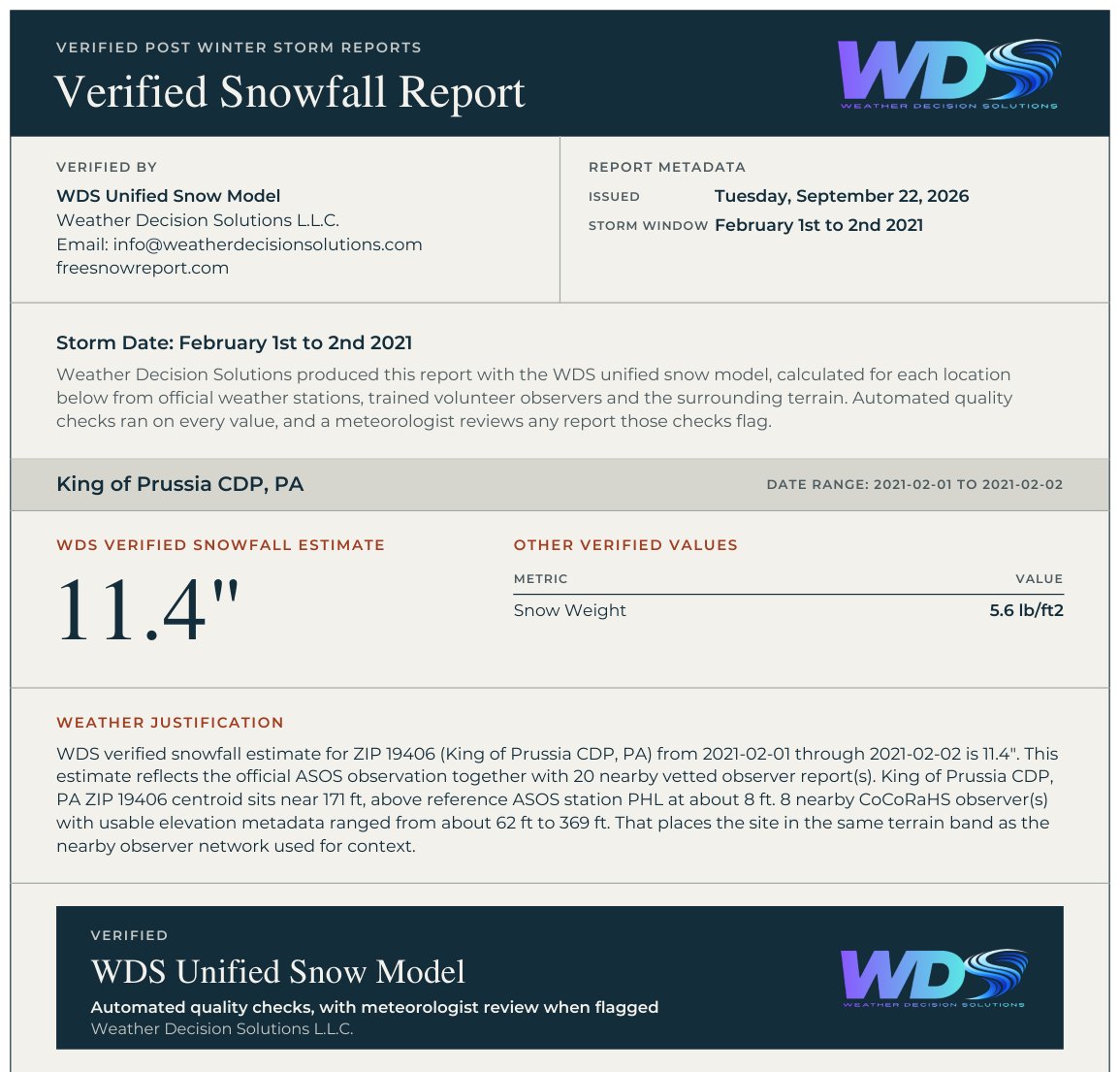
- Verified Report. A short summary with the storm total for your window, the weight of the snow and the quality checks.
- Full Report. The daily record at the nearest official station, the nearby observers and a map of the observations, so anyone can see what the estimate rests on.
The estimate is built from what stations and trained observers measured near the address, adjusted for elevation and checked against nearby measurements and the official record. Here is a real report for a storm in King of Prussia, Pennsylvania.
Limits to know
- A report covers a storm that ended at least two days ago, because observer networks finish filing about two days after a storm. For last night's snow, use your local National Weather Service office.
- One storm per report, up to three days. For a whole-winter total, NOWData and station files are quicker. For one storm in that winter, request that storm.
- Coverage is the lower 48 states and southern Canada. Alaska, Hawaii and the territories are not covered.
- It is an estimate. Totals are calculated from nearby measurements and are less certain where measurements are sparse. In some rural areas we hold the request and work on coverage before sending the report.
- It reports snowfall. It does not report snow depth on the ground or on a roof.
- It is not a signed or sworn record. If your situation calls for one, ask your attorney or adjuster what documentation they require.
Using a report for an invoice or an insurance claim
A report puts the dates, the address, the total and the sources in one document, so a customer, property manager or adjuster can see where the number came from. Whether they accept it is their decision. For a serious dispute, share the report with your attorney or adjuster and ask what else they need. We do not give legal advice. More on each case: snow totals for insurance claims, snow reports for contractors and proof of snowfall for snow removal billing.
Need totals for every site after every storm?
Weather Decision Solutions business members get verified snow reports automatically. See snow removal solutions. For signed analysis prepared for legal use, see forensic weather reports.
Questions people ask
How do I find out how much snow fell on a specific date?
Check a station record first. NOAA Climate Data Online and your local National Weather Service NOWData page give daily snowfall at official stations. For an estimate at your own address, request a Free Snow Report with the street address and the storm dates.
Can I look up past snowfall totals by ZIP code?
Yes. Enter a 5-digit ZIP code and the report is calculated for the center of that ZIP code. For a particular property, enter the street address instead, since snowfall can change a lot over a few miles.
Is there a way to see snowfall history by city?
Records for a city’s main weather station are free at NOAA Climate Data Online and on local NWS NOWData pages. Free Snow Report works one storm at a time, for any address, in the last ten years.
How much snow did we get last winter?
For a season total at an official station, use NOWData or Climate Data Online. For a particular storm at your address, request a report for it. A location pass ($149 for one ZIP code, 12 months) covers many storm reports in that ZIP code.
How much snow fell in my area or my town?
It depends on where it was measured. A town can have a station record and several volunteer observations that differ by a few inches. A report for a street address shows the nearby measurements and calculates the total for that spot.
How far back can I look, and how recent?
Any storm in the last ten years, as long as the last day of your window was at least two days ago. Observer networks finish filing about two days after a storm.
How much does it cost?
Each verified email gets three free reports. After that, a single report is $39. Location passes cover a ZIP code and every address in it for 12 months: $149 for one ZIP code, $349 for five, and $749 for 15, up to 100 reports per ZIP code.
Can I use it for an insurance claim or an invoice dispute?
You can share it. It documents snowfall at an address and date, with the sources printed on it. It is an estimate and not a certified record, and whether a carrier, contractor or court accepts it is their decision, so ask your attorney or adjuster what they need.
Sources
- NOAA NCEI: Climate Data Online
- NOAA NCEI: Global Historical Climatology Network daily (snowfall and snow depth)
- NOAA NCEI: Data certification (certified copies and fees)
- National Weather Service: NOWData climate data
- National Weather Service: how to measure snowfall
- CoCoRaHS: Community Collaborative Rain, Hail and Snow Network